
Case study
How Renew Now CE Increased Purchases by 21.7% Through AI Discovery
Renew Now CE deployed Second Wind to improve how AI systems discover, evaluate, and recommend its courses. Purchases rose 21.7% in a matched 45-day window, AI traffic grew ~79%, and the company ranked #1 in 64% of tracked buyer prompts across AI platforms.
45-day matched window · before vs. after deployment · same calendar dates
Purchase Growth
Matched 45-day window · Across all 22 optimized courses
Top Course Growth
+135% and +97% revenue across two courses
Ranked #1 by AI
Across buyer-intent prompts where RNCE was surfaced (Jun 1, 2026)
AI Traffic Growth
~1,400 → ~2,500 sessions/day
The challenge
Renew Now CE (RNCE) already had an established catalog and strong market demand. But the company was being inconsistently surfaced during high-intent buyer searches, limiting discovery during a growing share of healthcare education purchasing journeys. As more healthcare professionals began using ChatGPT, Gemini, and similar tools to find and evaluate CE providers, AI systems were recommending competitors more consistently than RNCE.
We deployed AI reference infrastructure, prompt-level monitoring, and targeted course optimizations built around RNCE's buyer personas, course clusters, and competitive differentiators.
Client perspective
What stood out to me wasn't just the visibility. It was finally being able to see how AI systems were evaluating us against competitors. That had been a black box. Second Wind made it measurable, and the analysis held up to the same scrutiny we apply to our own content, which matters a lot to me.
Joanna Nolte
CEO, Renew Now CE
Results
Total RNCE Transactions · matched 45-day windows
Pre-deployment
Second Wind live
Purchase growth
Key observation
The strongest signal was buyer volume, not basket size. Average order value grew modestly while purchase volume accelerated materially, consistent with more buyers discovering and selecting RNCE courses during provider evaluation, rather than existing customers simply spending more.
This is the primary observed effect. AI traffic growth, citation increases, and course-level performance are all supporting evidence for that central finding.
Same-catalog comparison
For the course-level analysis, we compared the 22 courses and packages directly optimized during the pilot against the rest of the catalog during the same matched window.
The directly optimized course set grew transactions by +21.7%, while the rest of the catalog grew +7.8%. Because Second Wind's technical and content improvements also affected the broader catalog, the +7.8% group is not a pure untreated control and may understate the engagement's full impact. Even against that benchmark, the courses Second Wind directly optimized grew roughly 2.8× faster than the rest of the catalog.
Second Wind AI Traffic Monitoring · renewnowce.com
Apr 23 – May 27, 2026 · avg 1,824/day · peak 3,906 · total 63,843
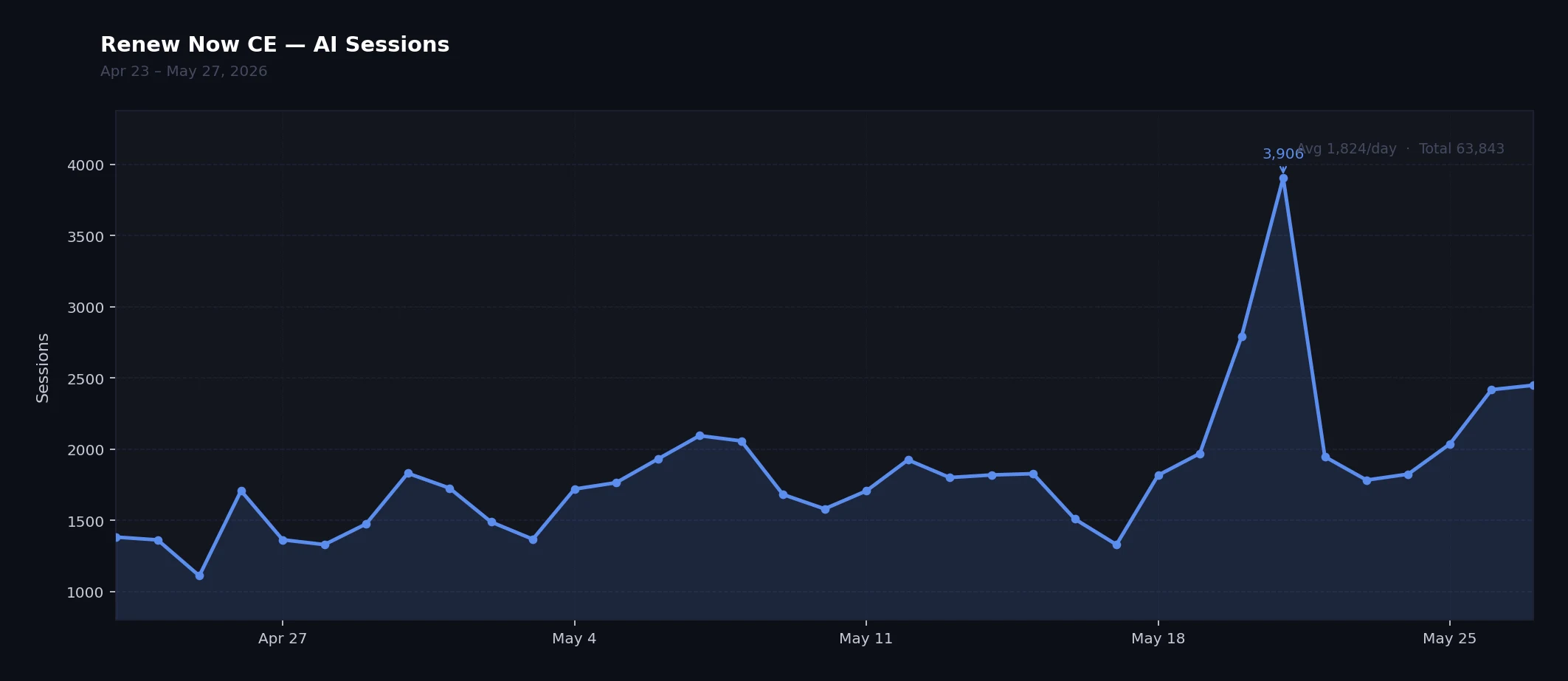
AI session: one visit by an AI agent (which may fetch multiple pages in a single pass) or a human click-through from an AI chat response. Multiple page requests from the same crawler in one pass count as a single session.
Reference Layer Citations in Probe Runs · ai.renewnowce.com
Source: Second Wind monitoring platform
Weekly monitoring · Apr 27 – Jun 1, 2026 · +52% since first indexed · 20–25% of RNCE's total citations
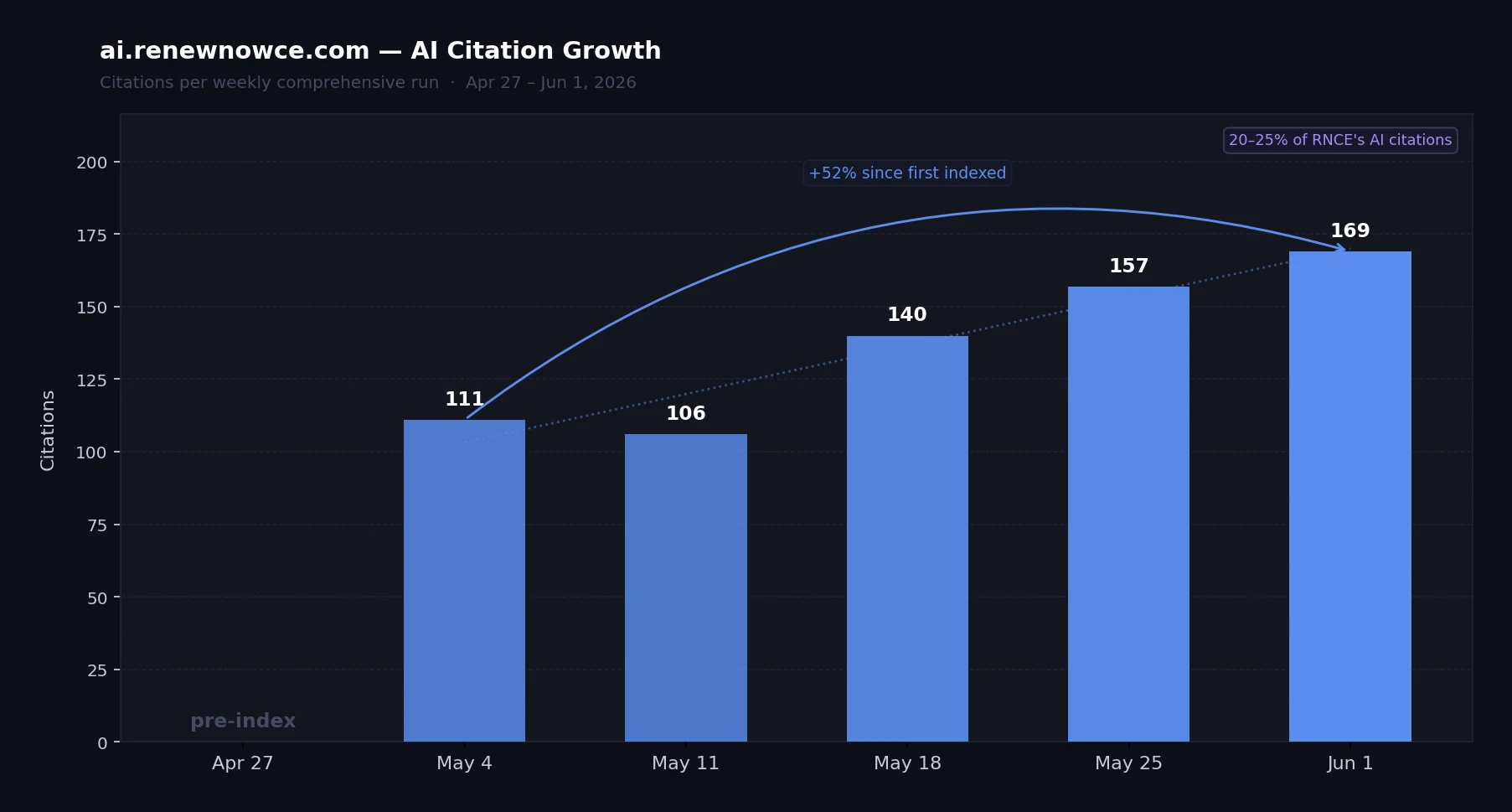
Traffic: Cloudflare edge-layer request telemetry (server-side, not client-side analytics). Citations: Second Wind weekly monitoring probe runs across 5 platforms.
Prompt-level monitoring confirmed the same directional pattern. By June 1, RNCE was ranked the #1 recommended provider in 64% of target buyer prompt responses when surfaced, and appeared in the top 3 in 89% of mention-bearing responses.
Avg Position
Order in AI ranking lists and recommendation responses
Ranked #1
Of mention-bearing buyer prompts
In Top 3
Of mention-bearing buyer prompts
Across monitored buyer-intent probes on ChatGPT, Gemini, Claude, Grok, Perplexity · Jun 1, 2026
Why the result is credible
Most before/after growth claims are difficult to interpret because of seasonality or concurrent marketing changes. RNCE compared the exact same calendar windows from 2025. Based on client confirmation, no major new marketing initiatives were added during the measurement window, which reduces one common confounding variable.
2025 · same calendar windows
Revenue: essentially flat
Transactions: softer volume (2,996 → 2,652)
2026 · Second Wind live
Revenue growth
Transactions: 3,139 → 3,821
RNCE was already growing year over year; this comparison is about the within-window transaction pattern. In 2025, revenue across the same calendar windows was essentially flat. The difference was transaction volume: 2025 showed softer purchase volume across the window, while 2026 showed material transaction acceleration during the Second Wind deployment period.
The optimized set consisted of 22 courses and packages that received direct AI-surface and course-level optimization work.
- Matched calendar windows, not rolling averages
- No major new marketing initiatives were added during the measurement window.
- Prior-year control compares the same windows within an already-growing business
- Attribution is not claimed exclusively; other concurrent business factors existed
The combined pattern, transaction acceleration against the prior-year window, AI traffic growth, and optimized-course outperformance, is what supports the interpretation, not any single metric in isolation.
Course breakdown
| Transaction Growth | |
|---|---|
| Directly optimized courses | +21.7% |
| Courses not directly optimized | +7.8% |
California Implicit Bias (1 Hour)
Transactions
Revenue
Illinois APRN Renewal Package
Transactions
Revenue
Additional optimized-course examples are omitted to preserve catalog anonymity.
Uplift extended across the broader optimized set, not only the two examples above. Performance varied substantially by course, consistent with real catalog behavior rather than uniform gains on every product.
A few optimized courses were flat or negative during the measurement window. They were intentionally retained in the analysis rather than excluded. A treated set that includes underperformers is more credible than a curated set of winners.
What changed
AI discovery infrastructure
We built and deployed a model-readable content layer at ai.renewnowce.com designed around the questions healthcare professionals actually ask when evaluating CE providers, mapped to RNCE's buyer personas, customer language, and the catalog they wanted to drive.
Recommendation monitoring & optimization
We ran ongoing monitoring across ChatGPT, Gemini, Claude, Perplexity, and Grok, tracking how often RNCE was cited, recommended, and surfaced relative to competitors during buyer-evaluation queries. Those insights informed the optimization work performed throughout the engagement.
Technical implementation sprint
Our diagnostic phase identified several technical issues limiting how effectively crawlers and recommendation engines could discover, interpret, and evaluate RNCE's content. We ran a focused implementation sprint and deployed the resulting improvements to production on May 30, 2026.
Methodology & limitations
The analysis used matched calendar windows (not rolling averages), comparing the same period before and after deployment. A prior-year seasonal control was run against the same windows in 2025 to separate seasonal pattern from deployment-period acceleration. Based on client confirmation, no major new marketing initiatives were added during the measurement window, which reduces one common confounding variable. Results were measured at the individual course level.
This was not a randomized controlled experiment, and it does not claim exclusive attribution to Second Wind. What it does claim is that the pattern across AI traffic, transaction volume, prior-year window comparison, and course-level outperformance is consistent with a discovery and recommendation effect. No single metric supports that interpretation alone. The pattern across all of them does.
Bottom line
Within 45 days, with no major changes to RNCE's existing marketing stack, AI traffic increased ~79%, purchases across 22 optimized courses increased +21.7%, outperforming the rest of the catalog by 2.8x. Multiple courses achieved near- or above-100% revenue growth.
RNCE moved from being inconsistently surfaced in AI-assisted buyer journeys to becoming materially more discoverable during provider evaluation and course selection.
Operations perspective
Working with Second Wind has been a refreshing approach to a stale business challenge. Growing organic traffic and conversions is mandatory in online commerce, but as search constantly evolves, it can be daunting to keep up. Second Wind helped move us into the next era of AI-optimized discovery, and the results have been tangible and meaningful. For such a technical process, the communication and collaboration have felt natural and enjoyable.
Dave Nolte
COO, Renew Now CE
If your target buyers are outsourcing research to AI agents, you should know whether they're finding you.
Second Wind shows where your brand appears, how agents evaluate you against competitors, and what needs to change to become the recommended answer.
Let's Talk