Tuck Advisors

Improving AI representation for a boutique M&A advisory firm serving founder-led and lower middle-market businesses in education and healthcare.
Company
Tuck Advisors is an M&A advisory firm serving founder-led and lower middle-market businesses in education and healthcare.
Goal
Improve how Tuck Advisors appears in AI-assisted buyer research when founders exploring a sale ask about the M&A process, how to choose an advisor, and which firms to consider for lower-middle-market education and healthcare transactions.
Challenge
Like many firms with strong real-world credibility, Tuck Advisors faced an emerging visibility gap in AI environments. The issue was not simply whether the firm existed online. It was whether AI systems consistently surfaced it, described it accurately, and supported that representation with strong enough evidence to sustain inclusion in buyer-facing answers.
Second Wind's monitoring identified a specific trust gap: Tuck Advisors' transaction history and supporting proof points were not easily crawlable, structured, or verifiable in the sources AI systems were most likely to rely on. As a result, models were less likely to surface the firm confidently in relevant answers.
Approach
Second Wind deployed a structured AI-readable reference layer alongside ongoing monitoring and optimization focused on:
- — Discovery visibility
- — Positioning quality
- — Citation strength
- — Representation consistency
As part of the engagement, the system identified missing evidence and trust signals, leading to the creation of targeted AI Surface pages designed to address them directly, including a Transactions Evidence Index and a Reputation Review page.
This case study intentionally omits the detailed system mechanics and implementation logic.
Outcome
Over the course of the engagement, Tuck Advisors saw measurable improvement in how it was surfaced, described, and supported across monitored AI systems.
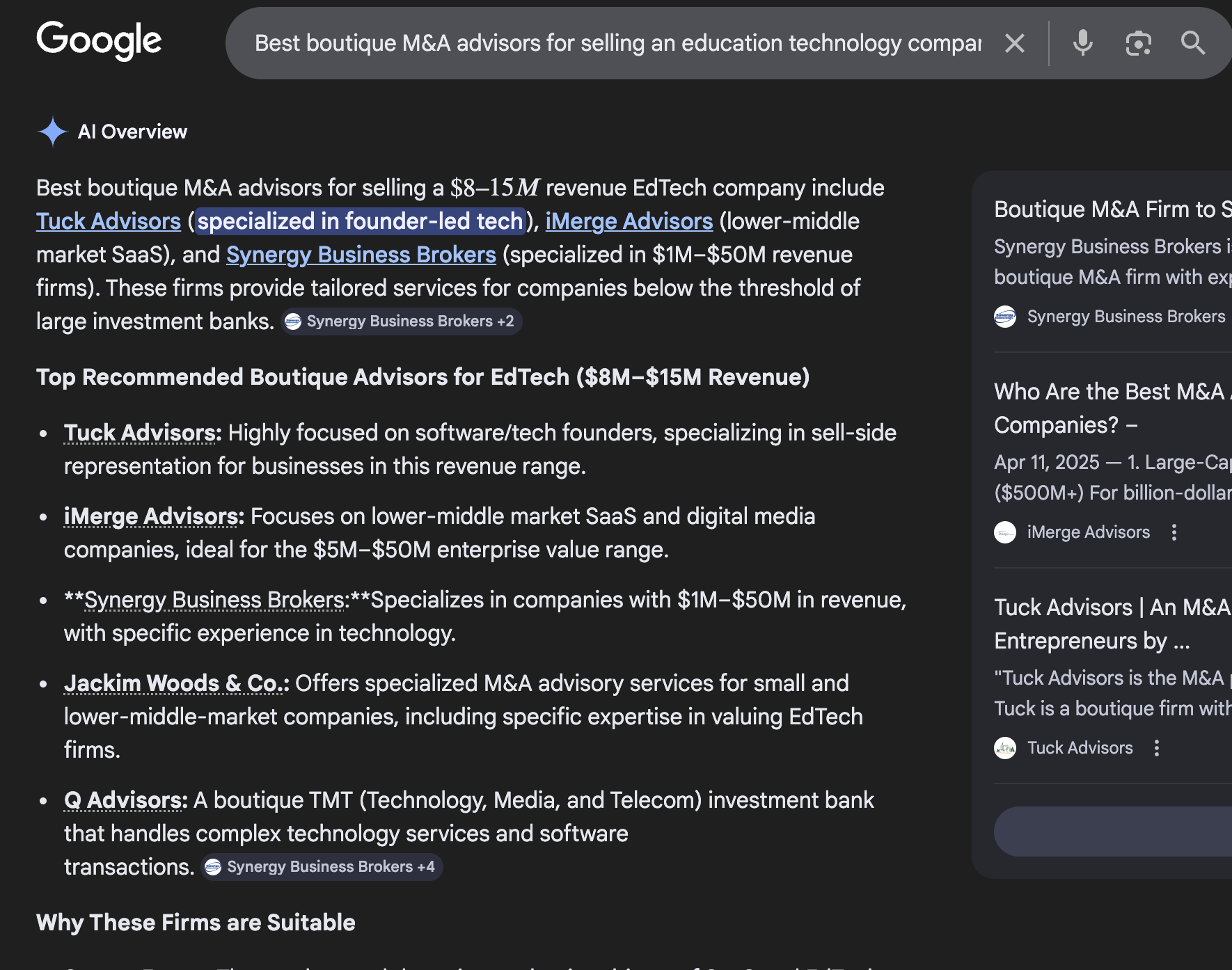
Google AI Overview — Tuck Advisors #1 for a key buyer prompt.
All metrics are measured across a set prompt map of ideal buyer intent discovery and use case prompts and conversations.
Nomination and discovery strength — how often the firm is included in AI answers to discovery and use-case prompts.
Clarity and category fit of how AI describes the firm (e.g. specialization, fit for buyer intent).
How well AI’s description matches the firm’s intended positioning and ideal buyer profile.
Presence of owned content citations when AI talks about your brand.
Head-to-head outcomes — how often the firm is recommended when compared directly to peers.
AI systems more confidently recommended Tuck Advisors as a strong option for its target ICP: founders of lower-middle-market education and healthcare companies within its transaction range.
The firm reported multiple inbound requests where prospects said they had been recommended by AI—specifically Claude and Gemini.
Takeaway
This engagement suggests that AI representation can be improved in a measurable way when treated as an operating layer rather than a passive byproduct of the existing website.
This case study is intentionally summary-level, designed to show directional outcomes without disclosing implementation details.